Website Migration
Website Migration, Planned and Managed Properly
Moving a website can sound straightforward until you start looking at everything connected to it. Pages, images, URLs, forms, analytics, tracking, SEO settings, integrations and, for e-commerce websites, products and customer data can all be affected by the move.
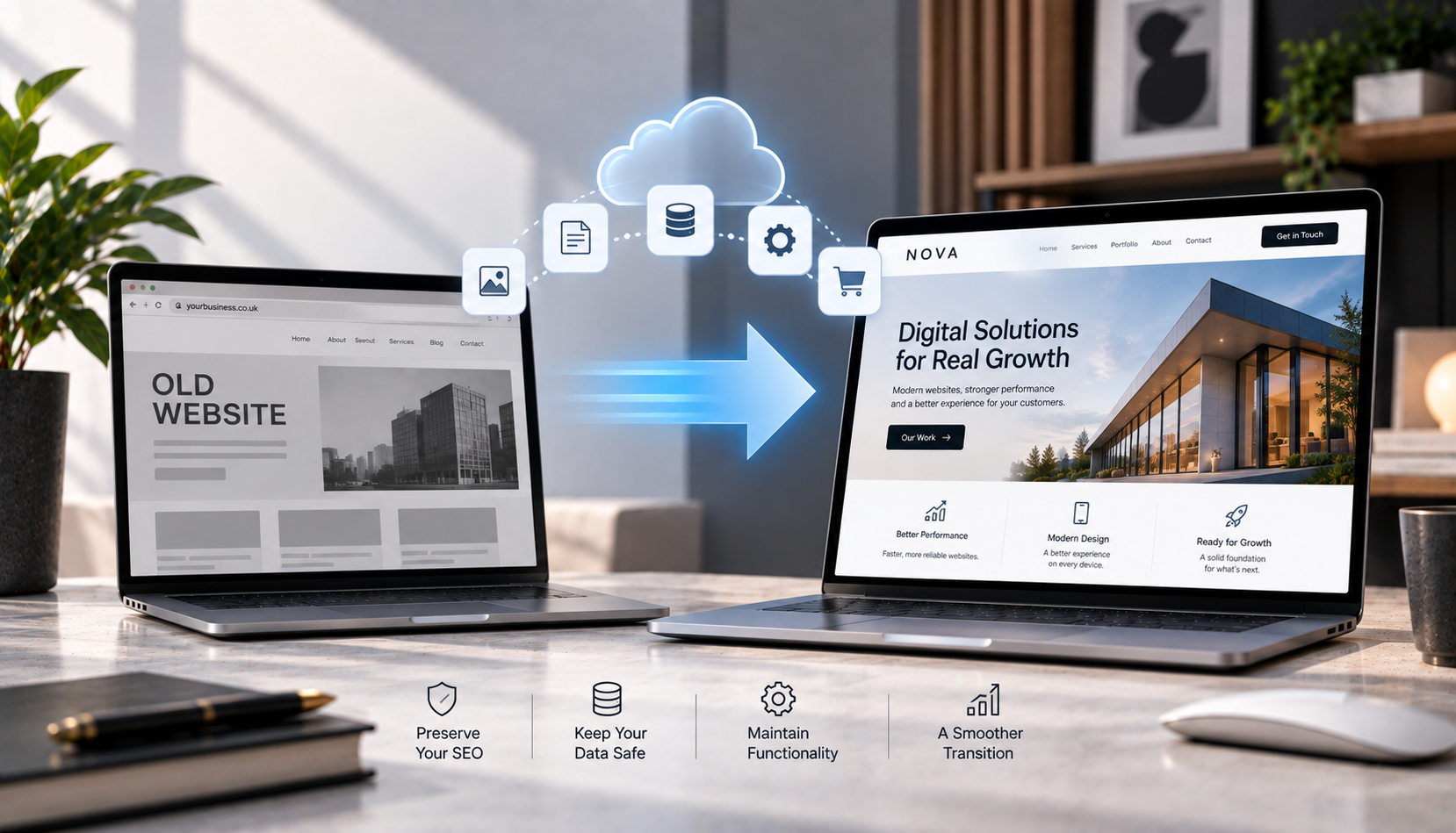
A Website Migration Is More Than Moving Content
Copying pages and images is usually the easy part. The important work is making sure the website still functions properly once the migration is complete.
Existing URLs may already be indexed by search engines. Contact forms may feed into other systems. Analytics and advertising platforms may depend on tracking codes installed across the website. An online store may contain hundreds or thousands of products, variations, customer records and previous orders.
All of those elements need to be considered before the old website is replaced.
We plan migrations around the existing setup and the destination platform, with testing carried out before the new website goes live. Where changes to the website structure are necessary, we also consider how those changes affect users and search engines rather than simply moving everything and dealing with problems afterwards.


What We Consider During a Website Migration
No two migrations are exactly the same. Moving a small company website between hosting providers is very different from migrating an established e-commerce store from one platform to another.
Depending on the project, our website migration process can include:
- Website and content migration
- Platform-to-platform migration
- URL structure and redirects
- SEO migration
- E-commerce data migration
- Performance and technical checks
- Launch and post-migration checks
Planning to Move Your Website?
If you are considering moving your website to another platform, changing hosting providers or replacing an existing website, it is worth understanding what needs to be preserved before making the move.
We can review your current website, the platform you are moving from and where you want to go next. From there, we can determine what can be migrated directly, what needs to be rebuilt and what needs additional attention to make the transition as controlled as possible.
FREQUENTLY ASKED QUESTIONS
How long does a website migration take?
The time required for a website migration depends on the size of the website, the platforms involved, the amount of content and data being transferred, and whether the structure of the site is changing. A smaller business website may be relatively straightforward, while an e-commerce or content-heavy website requires more preparation, migration and testing. We review the existing setup before establishing a realistic migration timeline.
Will migrating my website affect my SEO rankings?
A website migration can affect SEO if URLs, content, internal links or other important elements are changed without proper planning. Before migration, we review the existing structure and identify pages and URLs that need to be preserved or redirected. While no agency can guarantee that rankings will remain completely unchanged, a properly managed SEO migration can significantly reduce unnecessary disruption.
Can you migrate my website to a different platform?
Yes. We can manage platform-to-platform website migrations, including moves between WordPress, WooCommerce, Shopify, Wix and Squarespace where technically appropriate. Some elements can be transferred directly, while others may need to be rebuilt because different platforms handle content and functionality differently. We assess this before the migration begins.
Can an e-commerce website be migrated without losing products and orders?
In many cases, products, categories, variations and other store information can be migrated to the new e-commerce platform. Customer and historical order data may also be transferable depending on the source and destination systems. We review the available data first and determine what can be migrated safely rather than assuming everything can be transferred automatically.
Will my website experience downtime during the migration?
The aim is to keep disruption as limited as possible. Much of the migration and testing can usually be completed before changes are made to the live website. The final switch is then planned carefully, followed by checks of pages, forms, redirects, tracking and other important functionality. The exact process depends on the website, hosting environment and type of migration involved.